|
1
|
- I hear...and I forget
I see...and I remember
I do...and I understand
- Chinese Proverb
|
|
2
|
- Maria Andersen, Tom Donahue,
Jenny Klingenberg , and Diane Krasnewich
- http://www.alsi.net/Learning/Styles.htm
|
|
3
|
- Business Graphs
- The Establishment Shot
- Sequential Learners
- Global Learners
- Teaching Art
- Demand creativity and exploration
- Guide the student step by step
|
|
4
|
|
|
5
|
|
|
6
|
|
|
7
|
- Become better teachers
- Understand how the intellect functions
- Understand our own learning style and those of our students
- Apply this understanding to our teaching methodology
|
|
8
|
- Success teaching accounting online
- In identical classes and exam
- Online students did better on exams
- Article describing the outcome: http://www.alsi.net/Weblearning.htm
- Similar success teaching music online
|
|
9
|
- The more you do to help students learn, the less they learn.
- Tom’s Corollary: The more students accept responsibility for their own
learning and succeed on their own, the more they learn.
|
|
10
|
- How does the brain work?
- What is intelligence?
- How can I use Bloom's Taxonomy?
- What are learning styles?
- What is my learning style?
- How can I use learning style concepts?
|
|
11
|
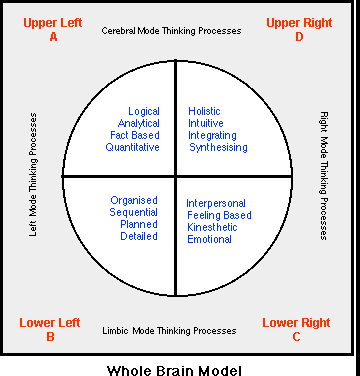
- Brain function and hemispheric dominance
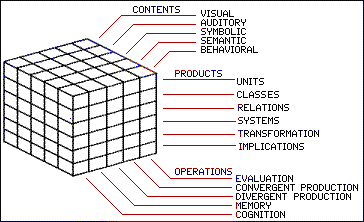
- Theories of intelligence
- Bloom's taxonomy
- Learning styles
- Personality styles
- Index of Learning Styles (ILS)
- Tomorrow: Application of the ILS
|
|
12
|
- Reptilian Brain
- Limbic Brain
- Neocortex
|
|
13
|
- Reasoning
- Logical
- Mathematical
- Verbal
- dominates right brain
- Mystical
- Musical
- Creative
- Visual-pictorial
- submissive to the left brain
|
|
14
|
|
|
15
|
- What teaching methods do you use for
- a student who is left brain
dominant?
- a student who is right brain dominant?
|
|
16
|
- Psychometric/Statistical Approach
- Information Processing Approach
- Piagetian Approach
- Sternberg's Triarchic Approach
- Gardner's Multiple Intelligence Approach
- Ceci's Bioecological Approach
|
|
17
|
- Thorndike, Binet, Terman
- Military needs of WWI
- Verbal and Mathematical (IQ)
- Aptitude vs. Ability
- Global intelligence (g factor)
- Learning "disabilities"
|
|
18
|
- Verbal Comprehension
- Word fluency
- Number
- Space
- Associative Memory
- Perceptual Speed
- Reasoning:
|
|
19
|
- Inductive Reasoning - students
- Deductive Reasoning – teachers
- (sequential vs. global learning style)
|
|
20
|
- Field dependent people
- Field independent people
|
|
21
|
- Sensory-motor
- Pre Operational
- Concrete Operational (7-11 years). Characterized by 7 types of
conservation: number, length, liquid, mass, weight, area, volume.
Intelligence is demonstrated through logical and systematic manipulation
of symbols related to concrete objects. Operational thinking develops
(mental actions that are reversible).
- Formal Operational Intelligence is demonstrated through the logical use
of symbols related to abstract concepts. Only 35% of high school
graduates in industrialized countries attain formal operational thought;
many people do not think formally during adulthood
|
|
22
|
- How can you develop
- Formal Operational Thinking habits?
|
|
23
|
- Construction
- Bridging
- Metacognition
- Cognitive conflict
- Analogies
|
|
24
|
- theoretical intelligence
- practical intelligence
- productive intelligence.
- analytical
(or componential)
- practical
(or contextual)
- creative
(or experiential).
|
|
25
|
- Interpersonal aptitude
for working with others
- Logical/mathematical aptitude
for math, logic, deduction
- Spatial/visual aptitude for picturing, seeing
- Musical aptitude for musical expression
- Linguistic/verbal aptitude
for the written/spoken word
- Intrapersonal aptitude for working alone
- Bodily/kinesthetic aptitude
for using your physical self
|
|
26
|
|
|
27
|
- Nature vs. Nurture
- Results from a conjunction of cognitive processes
- Assessment will depend on the context and domain that is measured
- Four types of context (physical, social, mental, and historical) greatly
influence how and what abilities are acquired and how those abilities
are expressed
|
|
28
|
|
|
29
|
- According to Labouvie-vief (1986) Older adults do poorly on measures of
formal reasoning ability, but this is because they approach problems
differently.
- Older adults tend to be more pragmatic, more attuned to social and
economic realities, so abstract questions don't seem as meaningful or
important.
|
|
30
|
- Old Age and Cunning
- Will Overcome
- Youth and Ambition
- Every time!
|
|
31
|
- 6. Evaluation
5. Synthesis
4. Analysis
3. Application
2. Comprehension
1. Knowledge
|
|
32
|
- Visual intake by seeing
- Auditory intake by hearing
- Kinesthetic intake by doing,
touching
- Some theorists add read-write to
- these three style preferences.
|
|
33
|
- Type 1: Innovative Learners are primarily interested in personal
meaning. They need to have reasons for learning--ideally, reasons that
connect new information with personal experience and establish that
information's usefulness in daily life. Some of the many instructional
modes effective with this learner type are cooperative learning,
brainstorming, and integration of content areas (e.g., science with
social studies, writing with the arts, etc.).
- Type 2: Analytic Learners are primarily interested in acquiring facts in
order to deepen their understanding of concepts and processes. They are
capable of learning effectively from lectures, and enjoy independent
research, analysis of data, and hearing what "the experts"
have to say.
- Type 3: Common Sense Learners are primarily interested in how things
work; they want to "get in and try it." Concrete, experiential
learning activities work best for them--using manipulatives, hands-on
tasks, kinesthetic experience, etc.
- Type 4: Dynamic Learners are primarily interested in self-directed
discovery. They rely heavily on their own intuition, and seek to teach
both themselves and others. Any type of independent study is effective
for these learners. They also enjoy simulations, role play, and games.
|
|
34
|
|
|
35
|
- Introvert – Extravert
- Sensing-Intuitive
- Thinking-Feeling
- Judging-Perceptive
|
|
36
|
- Visual: most people in our culture.
- Verbal: lectures, texts,
equations, chalkboard, overhead, PowerPoint, etc.
|
|
37
|
- Deductive teaching is quick and easy, but
- although it appears straight forward and easy for the teacher
- it is confusing and difficult for the student.
- Most students think and learn inductively.
|
|
38
|
- If you teach in your own preferred style, people like you are likely to
learn.
- If you teach in multiple styles, everyone is more likely to learn more
easily.
|
|
39
|
- Most curricula, textbooks, teaching techniques, and teachers are
sequential.
- Global learners make good researchers, systems analysts, and creative
problem solvers if they make it through school.
|
|
40
|
- List five learning styles
- Describe an extreme example of each style.
- Design a strategy to facilitate a learner that prefers each style
|
|
41
|
- Give students the global view or goal at the beginning.
- Teach inductively (step by step) and encourage students to reason
deductively.
- Ask questions and devise assignments that cause students to be
field-independent.
- Use the Socratic Method so students respond with their own dominant
learning style.
- Appeal to all the senses in your teaching.
- Plan for active learning. The most prominent learning mode is through
doing.
- Put students into situations where they develop formal abstract
reasoning capacities (e.g., use construction, bridging, metacognition,
cognitive conflict, analogies, etc.)
- Take pains to use the nondominant side of your brain in your teaching
methodology
- Devise lesson plans that use the opposite of your learning style
preference (students who have your learning style will catch on easily
it those who do not that are likely to have trouble in your class.)
- Vary assignments between visual, auditory, kinesthetic and read-write.
- Use visual approaches rather than lectures, equations, chalkboard,
PowerPoint, etc.
- Use course activities that address each of the different learning
styles.
|

 Notes
Notes